Send the robot first.
Drones, crawlers and caged confined-space drones go up stacks, into boilers and along ducts so your people don't have to, flown under SACAA Part 101 by licensed remote pilots, working with an approved operator (UASOC holder). Our engineers turn what they capture into findings, and tell you exactly where hands are still needed.
-
Inspection at height
5–8×faster first look
Scaffold alone has taken five to eight days to erect on SA gas spheres. Our first look takes a day on site.
-
First look inside a vessel
0people inside
A caged drone goes in first, so people enter only for the repair.
-
Footage to findings
72 hto signed findings
Every frame screened by AI and reviewed by an engineer, not left on an SD card.
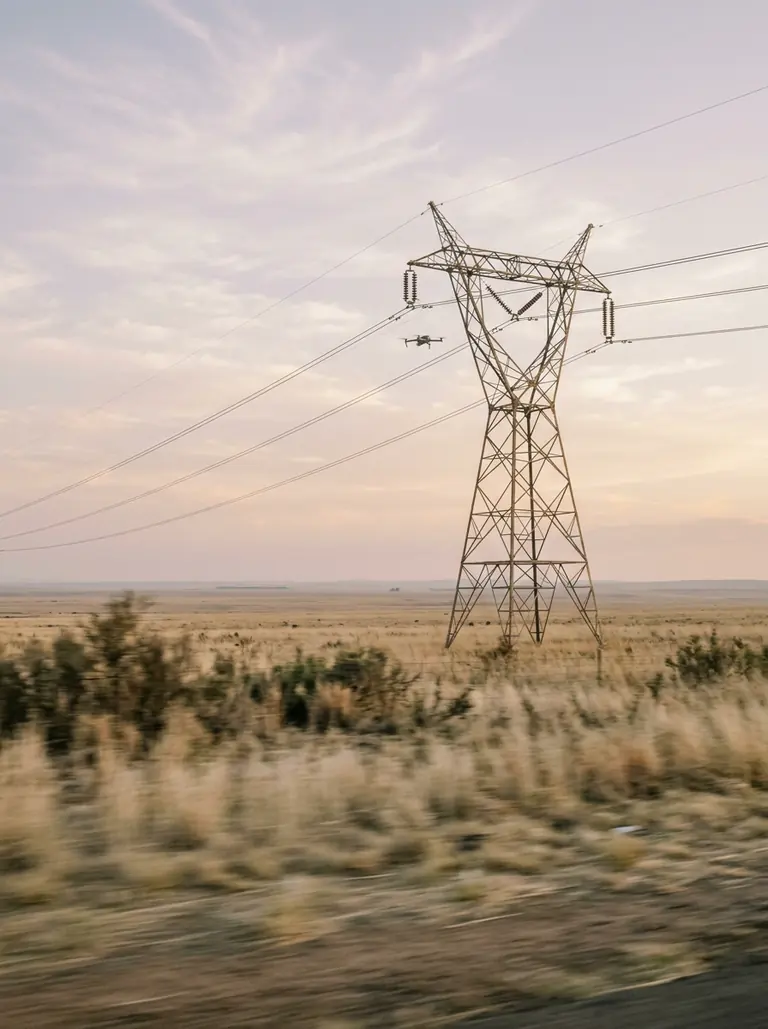
The week you know
Days of access for minutes of looking.
Scaffold before the look, permits before the scaffold, a cool-down before the permits. Most of an inspection is spent getting a person close enough to see, and every metre of height adds risk you sign for.
-
Monday · 06:30
Six days of scaffold for twenty minutes of looking.
The scaffolders arrive for the stack. One South African rope-access contractor put scaffold erection on a set of gas spheres at five to eight days. The inspector will need about an hour at the top.
What it costsScaffold hire, erect and strip crews, and a week of critical path.
-
Tuesday · 05:50
Cool down, then permits, then the sky climber.
The unit is off and the boiler is still too hot for entry. When it cools, the entry permits start. Then the internal access goes up. Only then does anyone see the tubes.
What it costsOutage days on a generating unit before inspection has even begun.
-
Saturday · 17:00
Day fifteen of a seven-day shutdown.
The shutdown plan said seven days. One reported boiler outage ran to 22, largely to build internal scaffold that turned out to be mostly unnecessary. You recognise the shape of that schedule.
What it costsWeeks of lost production, spent on access nobody ended up using.
-
Wednesday · 13:20
Somebody is going into that tank on a rope.
And you signed the permit. Confined space and work at height are where fatalities happen, which is why each entry needs a fall protection plan, gas testing, a standby and a rescue plan. All of that, just to look.
What it costsRisk carried by a person, and hours of preparation for every entry.
-
Thursday · 10:15
The crane costs more than the inspection.
To check wall thickness near the top of a flare stack, the usual answer is a crane and a basket. The quote for the crane is larger than the quote for the work, and the stack has to be safe to approach.
What it costsCrane hire, a lifting plan, and sometimes a shutdown purely for access.
-
Friday · 16:30
Three thousand nice photos. No report.
The drone operator was cheap and quick. The job ended at the SD card, and nobody checked whether he was licensed to fly commercially. Now an engineer has to turn footage into findings, and your SHE officer has questions.
What it costsDays of review, and footage you can't rely on if the paperwork wasn't there.
What we take off your plate
The flight, the findings, and the access decision.
We plan the mission, fly or drive it under your permit to work, and hand back findings an engineer has signed. Then we tell you where scaffold is still worth building, and where it isn't.
-
Mission plan Part 101
Risk assessment, flight or route plan, airspace and distance checks, and your permit-to-work inputs, ready for you to approve before anyone arrives.
-
Flight log and compliance record
For every mission: the pilot, the aircraft, the operator's certificate reference and the conditions on the day.
-
Raw and processed data
High-resolution visual, thermal, point clouds from inside vessels and, where specified, ultrasonic thickness readings, each tagged to its place on the asset.
-
3D model or orthomosaic
Where the job calls for it, a measured model of the structure, ready to feed a digital twin.
-
Engineer-signed findings
Every frame screened by AI, every finding reviewed by an inspector, and the report signed by the responsible engineer.
-
Access recommendation
Where scaffold, rope access or a crane is genuinely needed for hands-on repair or NDT, and where it is not. This is often where the money is.
-
Post-incident entry assessment
After a fire, collapse or release, live footage and exact damage locations before your people go back in.
How it gets done
One day on site. The robots do the climbing.
You approve the plan and issue the permit. Licensed remote pilots and our technicians run the mission, AI processes what they capture, and an engineer signs what it means.
-
Day 0Request
"Stack 2 needs a look before the shutdown."
That is all we need to start. AI pulls the drawings, the last inspection report and your site rules from the documents you share, and lays out what has been seen on that asset before.
- You
- AI reads the history
-
Day 0Plan
A mission plan you can sign.
Our engineer and pilot write the risk assessment and flight plan, and check airspace, the distance to the nearest aerodrome, the 50-metre rule and any approvals the job needs. You approve the plan and issue the permit.
- Engineer and pilot
- You approve
-
Day 1 · 06:30Toolbox
Toolbox talk with your SHE team.
The flight crew signs on under your permit to work. Exclusion zones are marked, the recovery plan for anything flown inside a vessel is agreed with the permit issuer, and the pilot's licence and the operator's certificate are on the table.
- Flight crew and your SHE officer
-
Day 1 · 07:30Fly
No person goes up, or in, for the first look.
An external drone for stacks, flares and structures. A caged drone inside boilers, tanks and silos. A crawler for ducts and pipes. A contact drone for thickness readings at height. A licensed remote pilot flies, with an observer alongside.
- Drones and crawlers
- Remote pilot
-
Day 1 · 18:00Process
AI works through the footage overnight.
Images and point clouds processed, candidate defects detected and located on the asset, readings plotted against the drawing.
- AI processes
-
Day 2Review
An engineer confirms, and decides on access.
Findings confirmed or rejected one by one, and the access recommendation written: what needs hands, where, and what kind of access will do. Anything critical is phoned through immediately.
- Engineer signs
-
Day 3Decide
You set the repair scope.
With the findings and the access recommendation in hand, you decide what gets repaired, and where scaffold goes up, if anywhere at all.
- You approve
-
Next timeRepeat
The same path, so the comparison is fair.
We fly the same route at the next inspection, so this year's images sit directly against last year's.
- Same route
What the day depends on. Wind, rain and light ground drones, and some sites need airspace approvals that take weeks to arrange, so we raise those on day zero. A boiler still has to cool before a drone goes in. And a drone replaces access built to look, not access built to repair: if the finding needs a welder, it still needs scaffold.
The old way, and with Kuumba
Same asset. Nobody on the rope.
| Area | The old way | With Kuumba |
|---|---|---|
| Access to look | Scaffold, rope access or a crane, built before anyone sees anything | A drone or crawler, in the air or in the duct the same morning |
| Time on site for a stack | Days of erecting before the inspection starts | One day, including set-up and the toolbox talk |
| Confined-space entry | A person goes in for the first look | A caged drone goes first; people enter only to repair |
| Boiler inspections | Start when the internal access is up | Start when the boiler has cooled enough to fly |
| Scaffold | Built wherever someone might need to look | Built only where hands-on work is needed |
| From footage to findings | An SD card and a week of review | Engineer-signed findings within 72 hours |
| Paperwork | "He has a licence, I think" | Pilot licence, aircraft approval and operator's certificate shared before the flight |
Where robots go, where AI helps, where people decide
Robots take the height. People keep the judgement.
Robots and AI do
The climbing, the crawling and the hours of footage.
- Fly stacks, flares, roofs and structures, and go inside boilers, tanks and silos.
- Crawl ducts and pipes no one should be inside.
- Repeat the same path every time, so results compare like for like.
- Screen every frame, locate each candidate defect and build the model.
- Draft the findings, the report and the access recommendation.
People decide
Whether to fly, what was seen, and what happens next.
- The mission plan, the go or no-go on the day, and the call to land.
- Every flight, flown by a licensed remote pilot within line of sight.
- Whether a flagged item is a defect, and how serious it is.
- Where access is still needed, signed by the responsible engineer.
- The permit, the repair scope and the budget: yours.
The footage feeds the same review as every inspection we do: see AI Inspection.
Standards we work to
Flown by the book your SHE officer checks.
Commercial flight in South Africa is regulated, and so is everything a drone replaces. Every mission plan names the rules that apply, so your permit issuer can sign it with confidence.
- Civil Aviation Act 13 of 2009The basis for drone regulation
- Civil Aviation Regulations Part 101Remotely piloted aircraft systems
- SA-CATS 101Classification and technical standards
- UASOC · ASL · RLA · RPLOperator certificate, air service licence, aircraft approval and pilot licence
- OHS Act 85 of 1993Permit to work and the client's site rules
- Construction Regulations 2014Reg 10 fall protection · Reg 16 scaffolding
- SANS 10085-1:2024Scaffolding, where it is still needed
- General Safety RegulationsConfined spaces and work in elevated positions
- MHSA 29 of 1996The mine's own codes of practice and risk assessments
- ISO 9712NDT qualification for contact thickness readings
- POPIA 4 of 2013Imagery that captures people
- BVLOSBeyond line of sight needs specific SACAA approval
Questions engineers ask
The questions we hear first.
Who is licensed to fly on our site?
Every mission is flown under SACAA Part 101 by licensed remote pilots, working with an approved operator that holds the UAS Operating Certificate (UASOC) and Air Service Licence that commercial flight requires. Every aircraft carries an RPA Letter of Approval, and third-party insurance is in place.
Either way, the certificate, licence and approval references are on your SHE officer's desk before anyone flies.
Can you fly near our plant, our people or the airfield down the road?
Part 101 keeps drones 50 metres from people and structures, and 10 kilometres from aerodromes, unless a specific approval is in place. Inspecting a structure means planning around that rule properly, not ignoring it.
We check all of it in the mission plan and apply for approvals where needed. Some sites need extra lead time, and we tell you on day zero.
Can you fly beyond line of sight, say along a 15 km conveyor?
Only where the operator holds a specific SACAA approval for beyond visual line of sight on that route. Otherwise we fly the route in line-of-sight segments with observers. It works; it takes longer, and we plan the day around it.
Does a drone replace scaffolding entirely?
No. It replaces scaffold built just to look. If a finding needs welding, grinding or hands-on NDT, someone still needs safe access.
What changes is that you build it once, in the right place, for the right job, because the access recommendation tells you exactly where.
What happens if a drone fails inside the vessel?
Confined-space drones are caged and built to tolerate collisions. Recovery is part of the mission plan: how it would be retrieved, by whom, and under which permit, agreed with your permit issuer before entry.
A lost drone is an inconvenience. That is the point of sending it first.
Will the footage show my workers?
It may. People are never the subject of the inspection, and footage is handled under POPIA. It is stored in your own isolated Kuumba Work environment, with client data stored in South Africa, and shared only with the people you name.
Related services
What the robots see goes further.
-
Digital Twins
A living model of your assets that grows sharper with every visit.
Read more -
Safety & HSE
Risks seen earlier, incidents closed out, every action followed to the end.
Read more -
AI Inspection
Every frame reviewed, every defect evidenced, nothing left to memory.
Read more
Kuumba Work
Where every flight becomes a record.
Our crews and engineers work in Kuumba Work, the AI workspace behind all our services. Mission plans, flight logs and findings sit together, so the next mission starts from what the last one saw.
- Ask the asset. "What did we see on stack 2 last March?" answered with the report and frames it came from.
- Missions as apps. Mission plans, flight logs and compliance records in tables your SHE team can filter.
- Approval before action. Nothing is sent or raised on your behalf until a person has approved it.
- Connected to your files.Building Microsoft 365 and Google Workspace connections, so drawings and permits arrive without a download.